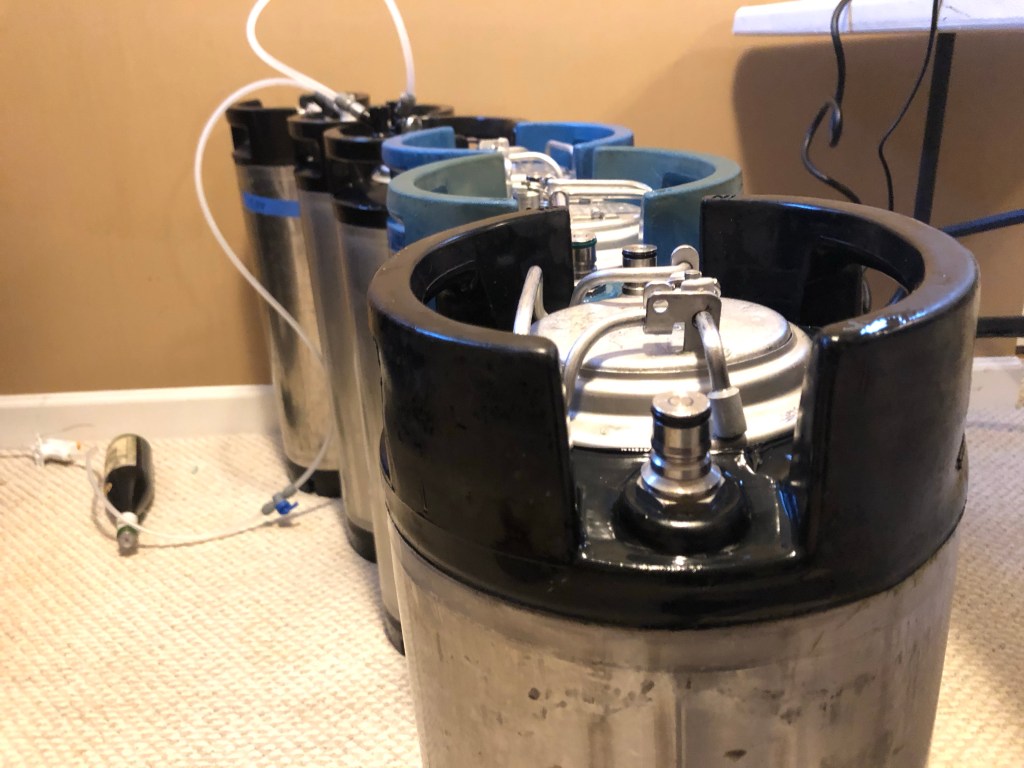
It’s been nearly half a year since my last brew day, and now that the snow cover is thawing I’m beginning to prepare for the 2021 brewing season.
To that end, I spent some time this week cleaning and reconditioning my four tap keezer.
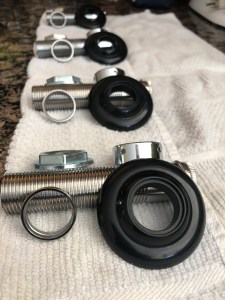
- Scrubbed the freezer interior
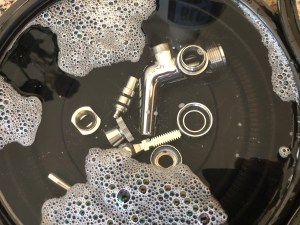
- Dismantled soaked and scrubbed the shanks and faucets
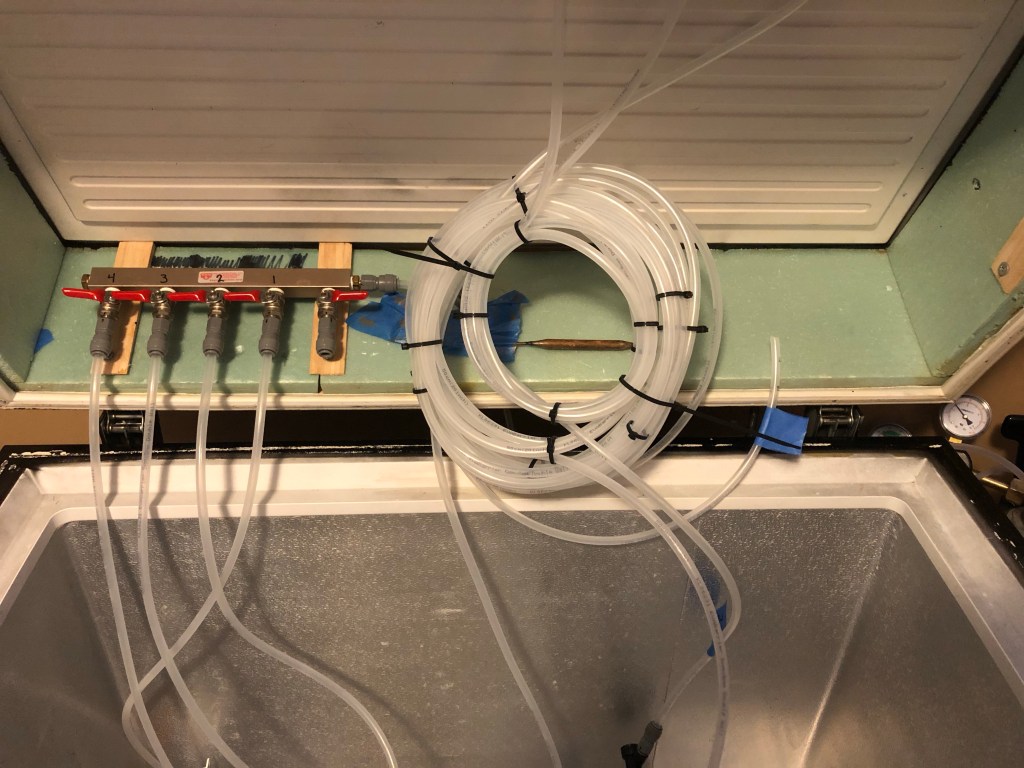
- Replaced all the old draft lines with new evabarrier lines and replaced all the chrome tail pieces and swivel nuts with duotight fittings
- Balanced the system to deliver a unique serving pressure to each faucet
- Washed, sanitized, purged and pressurized all of my kegs which are now waiting with giddy anticipation to be filled with beer.
With keezer and kegs empty and idle, I’ve taken this moment to organize and focus my keezer strategy. In a departure from the random and disorganized, haphazard rotation of beers this keezer is used to, I’ve dedicated each tap to a specific style category to help focus my brewing in 2021:
Line #1: Saison – mostly sub-4%, all ‘clean’ (Brett and mixed fermentation Saisons will be 100% bottle conditioned as part of my mixed fermentation program. I’ve never been too excited about anything sour or funky that I’ve kegged and this helps me to keep my draft system… well… clean). Serving pressure on this line is set high, 19 psi for kegs carbonated to around 3.0 volumes.
Line #2: Hoppy Beers. APAs, IPAs, the line can get kind of blurry here. A West Coast IPA is first, with stripped down malt profile and big resiny dank hop presence. Medium-high carbonation, around 2.6 volumes on these kegs so serving at 15 psi.
Line #3: Lager – up first is a Bavarian Pils (Barke Pilsner malt and a house blend of Noble hops). I see pale lagers dominating this tap, but that distinction still allows for a wide range – anything from Leichtbier to Bohemian to Helles Bock. 12psi for kegs with medium carbonation, around 2.4 volumes.
Line #4: Malt driven beers. This was kind of the wild card since I don’t really brew with too much character malt, but frequently wish I had something ‘malty’ and lower-abv. I think dedicating a line to this range of beers will force me to brew more of them. First out of the gate will be something like an Ordinary Bitter. I just picked up some ECY Newark Ale yeast (derived from the defunct Ballantine Brewery I think) which should do well in any British style. I also have some Thomas Fawcett amber and caramalt laying around . . . and the recipe is starting to write itself. Serving pressure on this line is set to 8 psi for soft carbonation around 2.0 volumes.
My mixed fermentation program is still going strong, with more than half a dozen mixed fermentation beers brewed last year resting in carboys, barrels and kegs- and about an equal number continuing to develop in bottles. First up this year will be a rebrew of my bright and sunny Historical Grisette. This has got to be one of my favorite home brewed beers to date, although it really didn’t start hitting its stride until about six months in the bottle. This time I’m shooting for something in the 2.6%-2.9% abv range.
My ingredient focus is driven by the style focus, but also by my affinity for local:
Malt: Deer Creek Colonial Pils for the Saisons and Lagers, accompanied by their wheat, spelt, and rye for Saisons. Also their Dutch malt (like a 10L Munich) to use in either of the above or in an IPA. Deer Creek Keystone (aka their standard 2-row malt) as base malt for the hoppy beers as well as the malty range. There’s also the aforementioned TF amber and caramalt, some Weyermann carapils for foam stability, and a little buckwheat malt for Saisons and mixed fermentations.
Hops: I’ve got the freezer stocked with Strisselspalt, Cz Saaz, and the Noble hops. Also, EKG which gets blended with Saaz for my base Spelt Saison and is of course perfect for that Ordinary Bitter. For finishing hops I’ve got Motueka, Nelson and Hallertau Blanc. And CTZ, Centennial, and Simcoe to bring that classic dankness to the IPAs.
Yeast: My house ale strain, fairly neutral (bioprospected in my back yard), should do well in the hoppy beers. For clean Saisons there’s my house blend of several strains. And my house mixed culture for the mixed fermentations. For the lagers I have fresh pitches of Omega Bayern and Wyeast Czech Pils, and I’m looking forward to trying this ECY Old Newark in an Ordinary Bitter.
Water is my filtered house water treated to attain recipe-specific profiles- for all but the Czech Pale Lager which starts with distilled.
So, six different yeast strains or blends, twelve hop varieties, and a handful of malts. Looks like a lot now that I have it on paper, but I feel like I have a strategy and some focused direction for the year. Time will tell.
 Counterpoint Brewing and Blending