THE HISTORY
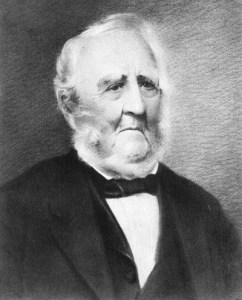
Ballantine holds a unique place in the history of American beer, and in the more recent story of American Craft Beer. The beginning of the Ballantine story sounds similar to many other breweries of the nineteenth and twentieth Centuries. First generation immigrant opens a brewery in his new home of the U.S., carrying on brewing traditions from his native land, the business finds success, the next generation eventually picks up the baton, the company continues to grow, and so on. In this case, it was Peter Ballantine who emigrated from Scotland in 1820 and opened a brewery in 1845 in Newark, New Jersey called P. Ballantine and Sons Brewing Company (which was in fact his third brewery venture in the U.S.), eventually bringing in his sons as partners in the family business.
Most of the breweries of the day would have been rooted in German brewing tradition, brewing Pilsners, Bocks, and other great lager styles. Ballantine was unique (though not entirely alone) in that this brewery was rooted in U.K. traditions, with a product line that included a Pale Ale, Brown Stout, Porter, IPA, and a Burton Ale. At some point in the late Nineteenth Century, Ballantine would add a lager to the lineup but the XXX Pale Ale unwaveringly remained their flagship. We often think of the history of American beer as dominated by fizzy yellow light lagers (especially during the mid- to late-Twentieth Century), and that’s mostly an accurate portrayal; so it’s stunning to me that by the 1890’s and as recently as the 1940s, Ballantine was bigger than Anheuser Busch, and that in the 1950s when Ballantine was at its peak, producing five million barrels a year, it was the third largest brewery in the country. An ale brewery. This certainly paints a different portrait of the mid-Twentieth Century beer landscape than commonly imagined.
Ballantine’s flagship XXX Ale would have been a beer of full character and flavor, quite different from the other players on the market by the 1950s, most of which seemed to be accelerating toward “making love in a canoe” territory.
By the 1950s at least, Ballantine ads made a point of differentiating their XXX Ale (known by then simply as “Ballantine’s Ale”) as bolder, stronger, more robust and characterful than other beers on the market. Ads for Ballantine’s Ale in the 50s, 60s and 70s focused on full flavor and aroma, even on specific premium ingredients, while most competitors were focusing more and more on the refreshment and drinkability factors of their light lagers. Ads for Ballantine’s own light lager (known simply as “Ballantine’s Beer”) show that contrast as well, focusing more on the beer’s light and refreshing nature (“Won’t fill you up; won’t let you down”) than on any distinguishing flavor or aroma characteristics. It’s interesting that Ballantine was promoting two beers as twin flagships by the 1950s, one Ale and one Beer. I’m now convinced that Ballantine is responsible for my early misconception of ale as something similar to but distinctly different from beer, which of course it is not.
Finding a reliably credible recipe for a Cottage-Cafe-era Ballantine’s has proven problematic. Complicating the issue is the fact that there have been so many iterations of XXX and IPA over the years (at least 100, according to brewing and malting consultant Fred Scheer). It’s widely believed that these two beers remained relatively unchanged between 1933 and 1971, but that after 1971, they progressively became “toned down” through the course of the 70s, 80s and 90s.
In 1971 the company was sold to Fallstaff Brewing Corporation after a decade of declining market share. Subsequently in 1972 the Newark plant was closed, and production of all Ballantine beers moved to Cranston, Rhode Island. Later, in 1979, Fallstaff moved their Ballantine production to a facility in Ft Wayne, Indiana, and in 1985, Fallstaff was acquired by Pabst Brewing Company precipitating another relocation of Ballantine production to Milwaukee, Wisconsin.
More moves would follow, as Pabst eventually ceased all brewing operations and now contract brews all of its 28 brands (mostly through MillerCoors). Through all of these moves, the beers continued to change, straying further and further from their original Newark iterations, and it appears that little care was taken to preserve documentation of the original- and I would say, the authentic– recipes of the Newark era.
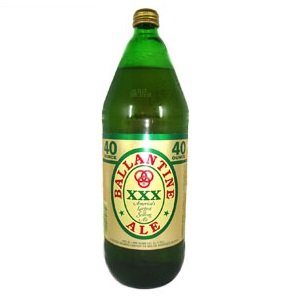
According to beer writer Greg Glasser in his article “The Late, Great, Ballantine,” (Modern Brewery Age, March 27 2000), the XXX Ale coming out Fallstaff in the 70s was a 5.6% abv golden ale with around 23 IBUs (maybe still somewhat resembling the original but with about half the IBUs); meanwhile overall IBUs on the IPA would drop from their original 60, first to 50, then 45 before being turned over to Pabst. Presumably these two beers accelerated down this slippery slope in an effort to attract the fizzy yellow beer market at the same time that beers like Sierra Nevada Pale Ale, Anchor Liberty Ale, and Samuel Adams Boston Lager were gaining regional traction for what was to become the Craft Beer segment. By the mid 90s, Pabst had discontinued Ballantine’s IPA and Martin Crane’s (you know, Frasier’s dad) beloved Ballantine’s Beer, leaving the constant flagship XXX Ale as the solitary representative of the once iconic 150 year old brand. Unfortunately, by this point the beer inside the bottle bore no resemblance to the Newark-era XXX whose label it shared, now little more than a fizzy yellow beer with slightly higher ABV. By the early 2010s it could be found in plastic twist-off 40 ounce bottles- appropriate packaging for what it had become, essentially a malt liquor.
All of this reminds me of a tragic movie I once saw, in which Andrew McCarthy and Jonathan Silverman show up at their boss’s beach house, only to find him deceased. Refusing to let his inconvenient demise spoil their weekend, they proceed to drag the lifeless corpse of their party-hardy benefactor along for a weekend’s worth of hijinks. Unfortunately, these two clowns just can’t accept that no amount of shoulder propping, sunglass copping, or collar popping can disguise the fact that Bernie has ceased to be. As the movie drags on, the empty shell progresses quickly into decline, resembling less and less the man who once occupied it. Similarly, green glass bottles with that familiar XXX label may have continued to be pushed to market for the next several decades, but it’s clear to anyone paying attention that Ballantine’s XXX Ale died that day in May, 1972 when the Newark brewery closed.
So where are the recipes, the notes, the brewing logs that would shine a light on what this beer was in its heyday, or at least point a humble home brewer in the right direction? I’m not even looking for a recipe as such; I just need to know ingredients, maybe percentages, and a few key data points like starting and finishing gravity and IBUs.
Short answer: nobody seems to know. In 2014, when newly-appointed Pabst Brewmaster Greg Deuhs began talking to the press about his pet project and Pabst’s attempted entry into the Craft market, the Ballantine IPA reboot, he claimed to have pieced together a recipe from “analytical data” he had found as well as interviews with older drinkers who “remembered the original.” Even he, who had access presumably to all of the documentation in the Pabst arsenal, could not locate a recipe. What he ended up with was a formulation that included eight different malts (highly unlikely in the simpler days of the Newark era) and a plethora of hop varieties, most of which did not exist in the 1960s.
Search any of the more popular home brew discussion forums and you will find a number of threads on the topic. There was a good bit of chatter about ten years ago, with guys declaring that to “clone” this beer has been their lifelong pursuit. Plenty of recipes, all of which appearing to be for the Falstaff or later version, or else just wrong.
Still, there may enough breadcrumbs to lead me down the right path if I can find them . . .
 Counterpoint Brewing and Blending
2 thoughts on “Ballantine’s Ale – Riffing on a Missing Link, Part 2”